

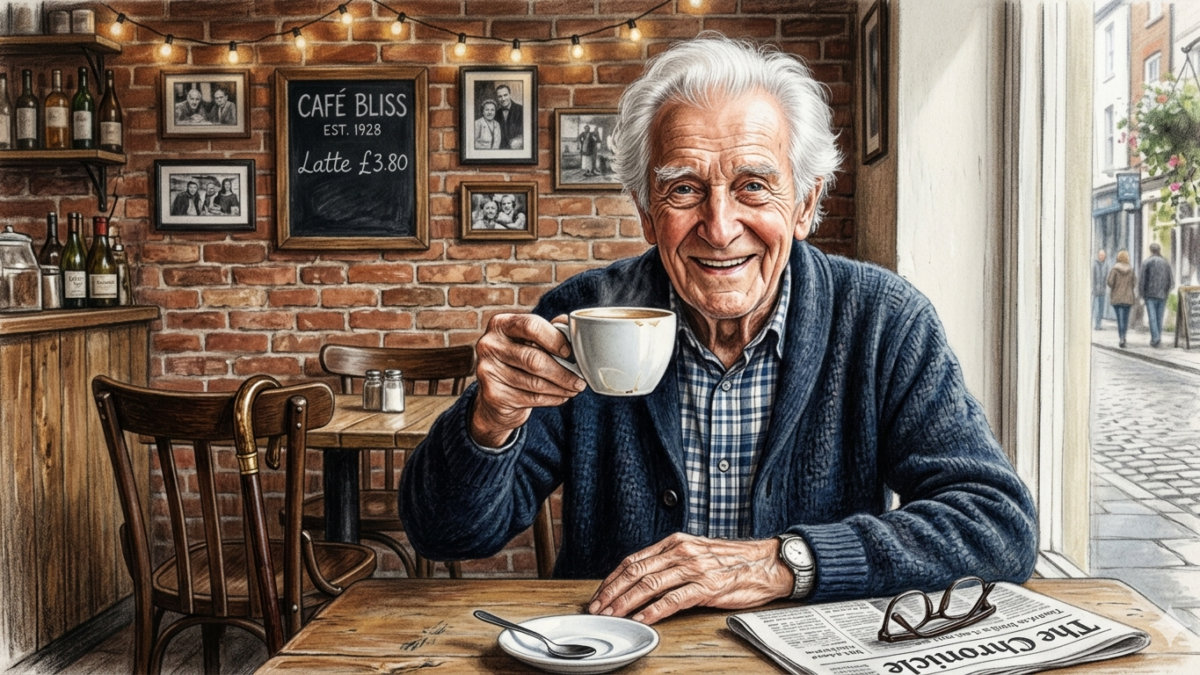

Martin Eden and Uncle Albert
Stepping out of the house and blending into the street, it hit me: reading fiction out here felt entirely pointless. A novel belongs behind closed doors, or in total isolation. Out in the wild, a thousand living, breathing stories are constantly competing for your attention.
It was a June afternoon in Kingston—one of those British summer days where the sun and the clouds were locked in a moody, relentless wrestle across the KT2 skies.
With a paperback heavy in my backpack, I had finally broken free from the confinement of my four walls. Rare for me, really.
I ducked into Costa, already running the usual mental script for the barista. (“Hi, how are you? — Good, thanks. — Warm out today, isn’t it? — Can I get a flat white, please?”) //A nervous childhood reflex that never quite left me.//
All I wanted was to claim the most tucked-away table in the far corner, slide into the shadows, and disappear back into Martin Eden’s grueling laundry days. My notebook was sitting right beside me, on guard, just in case a sudden stroke of luck allowed me to capture a line or two.
I opened the book, took a slow sip of my coffee, and let the pages swallow me whole.
Time blurred. I only surfaced once for a cigarette, once for the loo, and once to order a second round.
Then, the ambient noise of the café fractured. Loud shifting, the scraping of wood on tile, and a sudden change in momentum drew my eyes away from the page and locked them onto the table across from me.
An old man, looking every bit of ninety, was leaning at a precarious 75-degree angle. With trembling hands and a sort of fierce, quiet patience, he was trying to hook his walking cane onto the edge of the empty chair next to him. My heart hitched. I sat there frozen, holding my breath like a spectator at a high-stakes thriller, waiting for the crash. Every muscle in me wanted to jump up and reach out, but a few years of living in this country had taught me not to cross that invisible boundary of British independence. (Ah, every age is beautiful here, isn’t it?)
For what felt like an eternity—though it couldn’t have been more than a few minutes—the old man wrestled with that cane. He wasn’t rushing; he didn’t even seem to mind. Finally, the wood caught the fabric. He stared at it, ensuring it wouldn’t budge, and then began the equally terrifying descent into his own seat, relying entirely on the brick wall for support. Across from him, my own hand instinctively moved to my chest, trying to steady my racing pulse.
He made it down. Thank God.
As he settled, his eyes swept up and caught mine. He gave me a warm, knowing nod. Caught off guard and still trembling from the vicarious panic, I offered a tense, fleeting nod back—like a startled deer caught in the headlights—and quickly averted my gaze. Immediately, a cynical inner orchestra started playing in my head, mocking my awkwardness. Why couldn’t you just smile back? What are you so afraid of?
The man’s name was Albert. I pieced it together a moment later when another regular passed his table—an older chap, though noticeably sprightlier than Albert. Albert began to talk, his voice suddenly filled with an immense, childlike joy. He was describing the local farmer’s market from last weekend. Turns out his daughter ran the cheese stall there. She made everything from scratch on her farm, he said. Every single wheel was a masterpiece; everyone simply had to try it.
Albert kept pouring his heart into the story. Listening to him, completely spellbound, I looked down and realized I had closed my book. It was just sitting forgotten on my lap. Martin Eden could wait until I got home. Right now, Uncle Albert owned the stage.
I sat there in absolute awe of his vitality, his warmth. Yet, looking at him triggered that quiet, heavy anxiety of watching oneself decay. It made me hyper-aware of how effortlessly my own young body moved, while simultaneously serving as living, smiling proof that life, in all its fragility, beautifully persists. He was so much more vibrant, so much more real than the ink on my pages.
Lost in thought, I hadn’t realized I was staring. But Albert did.
He lifted his porcelain cup toward me, caught my eye, and said, “Cheers, love!”
Every ounce of blood in my veins revolted and rushed straight to my cheeks. But this time, instead of retreating into my shell, a sudden, unexplainable surge of confidence took over. I reached down, lifted my second drink—a Cortado I’d ordered purely out of the guilt of taking up space—mirrored his toast, and managed a genuine, radiant smile.
Martin Eden wouldn’t have been angry. He was my companion for the lonely hours, a man who spent his life trying to dissect the human condition. If Martin were sitting in my shoes, I know he would have done the exact same thing. He would have raised a glass with those calloused hands and that gentle soul of his and roared, “Cheers, mate Albert!”
But I wonder. If Uncle Albert knew that a foreign woman, a total stranger, was romanticizing his youth from across the room—picturing him exactly like the raucous teenagers currently drifting past the café window—I wonder what he would think?
*
